
By Emerald Law LLC · Last updated
- Home
- How to Apply for a Muslim Divorce in Singapore
How to Apply for a Muslim Divorce in Singapore
How to Apply for a Muslim Divorce in Singapore
- August 7, 2026

How Do I Apply for a Muslim Divorce in Singapore? Steps and Documents
By Rizuan, Joint Managing Director, Emerald Law LLC · Last updated: September 2026
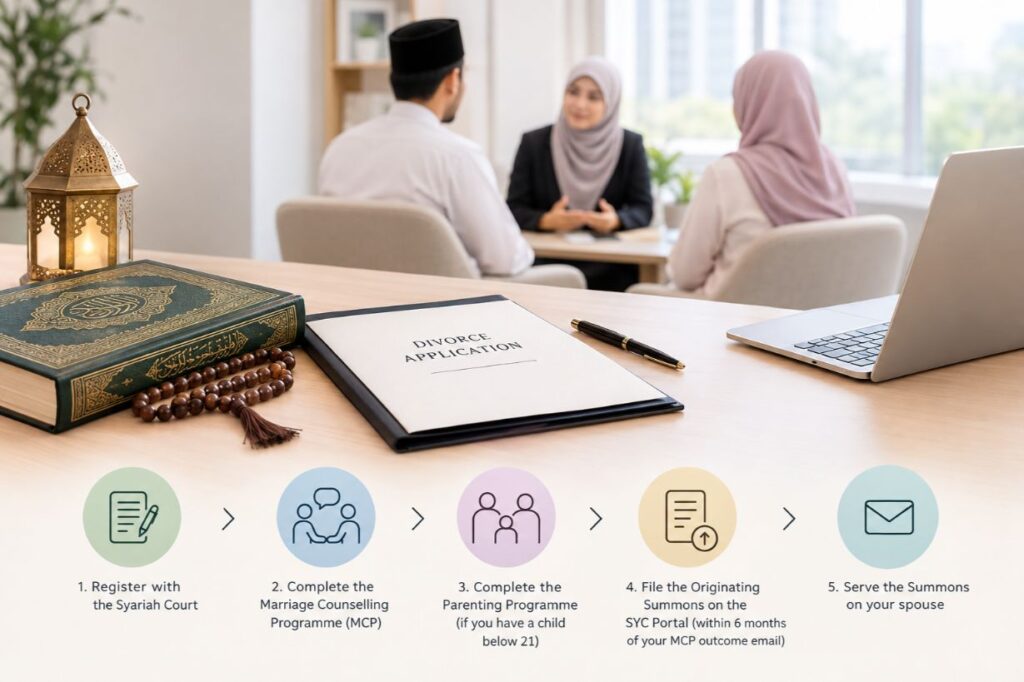
To apply for a Muslim divorce in Singapore, register with the Syariah Court and complete the compulsory Marriage Counselling Programme, plus the Parenting Programme if you have a child below 21. If you wish to proceed, file the Originating Summons for divorce on the SYC Portal within six months of your MCP outcome email, then serve it on your spouse.
Do I have to attend counselling before I can file for a Syariah divorce?
Yes. For most couples the Marriage Counselling Programme (MCP) is compulsory, and you cannot commence divorce proceedings until you have completed it. Registration with the Syariah Court is not the divorce itself — proceedings only start when the Originating Summons is filed.
After you register, the Court accepts your registration and you schedule your first counselling session with one of the community agencies appointed by the Syariah Court. The programme gives both spouses a neutral space to talk about the marriage and to understand what divorce will mean for the family.
In this video I set out the first steps of a Syariah Court divorce. Registration and counselling come before any filing.
Some parties are excluded from the MCP at the registration stage; the Syariah Court decides this case by case, so check your registration outcome carefully before assuming you can file straight away. Separately, you may ask to be exempted in the “Exemption from Counselling” section of the registration form if a critical or terminal illness, or a physical disability or infirmity, makes attendance impractical or impossible. The Syariah Court asks for proof such as a letter from a registered medical practitioner dated not more than one month before you submit your registration.
What documents do I need to file the Originating Summons for divorce?
You file the Originating Summons for divorce yourself on the SYC Portal, using the reference details in your MCP outcome email. The core filing is the Originating Summons (issued by the Court) together with a Case Statement — an e-form for the husband or the wife — and its accompanying documents.
What you will normally need to hand:
- The email titled “(Pre-OS Email) Marriage Counselling Programme Outcome: Proceed with Originating Summons for Divorce”, for the issuance date and case reference.
- Your MCP registration number.
- Your marriage certificate details and both parties’ identification and address particulars.
- Your Case Statement, setting out your claims — talak or fasakh, mutaah, nafkah iddah, the matrimonial flat, custody, care and control and access.
- An Agreed Parenting Plan (signed by both parents) or a Proposed Parenting Plan, if there is a child below 21.
- An Agreed Matrimonial Property Plan (signed by both parents) or a Proposed Matrimonial Property Plan, if there is a HDB flat owned by the husband and/or the wife.
- Supporting documents on the flat, CPF and income, where your claims depend on them.
The Syariah Court points self-represented parties to the Ministry of Law’s guidance tool (eBantu) for information on how to fill in the Case Statement or the Memorandum of Defence, and says plainly that its staff cannot draft the contents of any document for you.
In our experience, the Case Statement is where self-filed applications go wrong: claims are left blank, understated, or written as complaints about the marriage rather than as clear, quantified reliefs. What you claim at this stage frames the whole negotiation on mutaah, nafkah iddah and the matrimonial assets.
What are the stages of a Syariah divorce, from registration to hearing?
The process runs in a fixed order: registration, counselling, filing, service, mediation, pre-trial conference, and then hearing or hakam if matters remain in dispute. The Legal Aid Bureau’s overview of Muslim family law procedure sets out the same sequence.
Stage | What is filed | Who does it | Typical waiting time
|
|---|---|---|---|
Registration | Registration for divorce / MCP on the SYC Portal | Either spouse | Before proceedings start — registration is not the divorce |
MCP (and Parenting Programme if a child is below 21) | Attendance at an appointed agency; parenting plan discussed | Both spouses | Your first counselling appointment is scheduled with an appointed community agency after the Court accepts your registration |
Filing the Originating Summons | Originating Summons, Case Statement, parenting plan | Plaintiff (or solicitor) | Must be filed within 6 months of the MCP outcome email |
Service | Service bundle; Acknowledgment of Service filed on the portal | Plaintiff (or solicitor); Court process server only where the defendant is in prison and the plaintiff is unrepresented, at $29 for one attempt | Within 12 months of the date the filing is accepted |
Memorandum of Defence | MOD e-form and accompanying documents | Defendant | Within 21 days of service |
Mediation | Settlement terms, if agreed | Both spouses | Appointment shown on your portal Dashboard |
Pre-trial conference | Directions; affidavits of evidence-in-chief and replies | Both spouses | Further conferences are fixed by the Court as directions are given |
Hearing or hakam | Affidavits; hakam appointment where ordered | Court / appointed hakam | Dates and affidavit timelines are fixed by the Court at the pre-trial conference |
Two timing rules matter most. You must file the Originating Summons within six months of the date of your MCP outcome email. And under the Syariah Court Practice Directions 2025, an Originating Summons “may not be served more than 12 months beginning with the date of its issue, unless its validity is extended by an order of court”; the Syariah Court’s service page puts the same 12-month period by reference to the date the filing of the Originating Summons is accepted.
How do I serve the divorce papers on my spouse, and what if I cannot find them?
Once the Originating Summons is issued, you must bring it to your spouse’s notice. The Syariah Court’s guidance on service allows service personally, by registered post, or through the SYC Portal where you have given a valid email address for the defendant.
The step people forget is the paperwork that proves it. If you serve by registered post, service only counts once your spouse signs the Acknowledgment of Service form and you file that signed form on the SYC Portal. Without it, the Court treats the Originating Summons as not served.
If service through the portal is used, the defendant must log in and accept service for it to take effect.
Where your spouse has moved overseas, changed address or simply will not respond, the proceedings still have to be brought to their notice. That is what applications for substituted service are for. We usually start by documenting every attempt made: visits to the last known address, messages, emails, contact through family members. The Court wants to see genuine attempts before it will allow an alternative method.
In short, you can still get a divorce even if your spouse cannot be found, provided that the necessary applications are made at the Syariah Court.
What happens after my spouse is served — mediation, pre-trial conference or hearing?
After service, the defendant must acknowledge receipt and file a Memorandum of Defence within 21 days of service. The notice to the defendant in the prescribed Originating Summons form puts it as filing the MOD “within 21 days after the day on which you receive this Originating Summons” (Syariah Court Practice Directions 2025). You will then be given an appointment for mediation or a pre-trial conference, which appears on your SYC Portal Dashboard.
Mediation comes first in most cases. If everything is agreed — the divorce itself, mutaah, nafkah iddah, the flat and the children — the terms are recorded, talak is pronounced or confirmed before the Court, and a consent order is made.
If at the first Mediation session, an agreement is reached on most of the matters, a further Mediation can be fixed to sort out any remaining matters. This will give parties the ability to further negotiate since they are already so close to agreement.
If matters still remain in dispute, the case then goes to a pre-trial conference, where the Court gives directions and timelines for affidavits of evidence-in-chief and replies before the hearing. Where the marriage itself is disputed, the Court may refer the parties to hakam (arbitration).
Children’s issues often take the longest. If you are unsure what you are actually asking for, read our explanation of what custody, care and control mean and how child maintenance is applied for in Muslim marriages before mediation.
How much does it cost to file a Muslim divorce at the Syariah Court?
There are two separate costs: the Court’s filing fees, and legal fees if you engage a lawyer. Filing fees are payable on the SYC Portal by PayNow or eNETS/credit card, and the current amounts are published on the Syariah Court’s fees page, which sets out an estimate of the maximum court fees payable at each stage. One trap to note: the filing fee for an application or document that the Court Registry returns or rejects is not refunded, although a returned document may be resubmitted within the same filing transaction without paying again.
One fee is fixed and worth knowing: where the defendant is in prison and the plaintiff is unrepresented, the Court’s process server will make one attempt at service for $29.
The Court’s fees are modest compared with the value of what is usually being decided — the flat, CPF moneys and maintenance.
Our own fees depend on whether the matter is uncontested or contested, and on how much work is needed on the Case Statement, service and mediation. You can see the scope of work we handle on our Syariah and family law services page.
Do both husband and wife have to agree before a divorce can be filed?
No. One spouse can commence proceedings alone. Agreement changes how fast and how cheaply the matter ends — not whether it can start.
A husband may apply on the basis of talak; a wife may apply for fasakh, or on other grounds recognised under Muslim law and the Administration of Muslim Law Act 1966, which governs the Syariah Court’s jurisdiction over divorces between Muslims in Singapore.
If your spouse disagrees, they file a Memorandum of Defence and the case proceeds to mediation and, if needed, a hearing. Silence does not stop the case either — provided service has been properly effected or the Court has allowed substituted service.
In my experience, the more useful question is not “will my spouse agree to the divorce” but “what will we disagree about” — usually the flat, mutaah quantum and care and control. Those are the issues worth preparing properly at the Case Statement stage.
Frequently asked questions
Can I file for divorce at the Syariah Court without my spouse's agreement?
Yes. You may file the Originating Summons on your own once you have completed the Marriage Counselling Programme and received the outcome email allowing you to proceed. Your spouse can contest the claims by filing a Memorandum of Defence, and the Court will then deal with the disputed issues at mediation and, if necessary, at a hearing.
Is the Marriage Counselling Programme compulsory for everyone?
The MCP is compulsory, and it is the normal route for couples who register a divorce case with the Syariah Court. Some parties are excluded at the registration stage — the Court decides that when it processes your registration — and exemption may be sought on medical grounds such as critical or terminal illness or a physical disability. If your registration outcome says you are excluded, the SYC Portal will guide you to the filing step instead.
How long is my MCP outcome email valid for?
Six months. The Syariah Court asks you to take the date of the “(Pre-OS Email) Marriage Counselling Programme Outcome” email as your reference date, and the Originating Summons for divorce must be filed within 6 months from the date of that issuance email. If the window lapses, you will generally have to go back to registration and counselling before you can file.
How long does my spouse have to file a Memorandum of Defence?
A defendant who wishes to be heard must file the Memorandum of Defence within 21 days after being served with the Originating Summons. The MOD is an e-form completed on the SYC Portal with its accompanying documents. Missing the deadline can mean the case proceeds without your position properly on record.
Can I withdraw my divorce application if we reconcile?
Yes — reconciliation is possible at any stage, and the Syariah Court has a reconciliation process for couples who change their minds. Withdrawal is done by filing a Notice of Withdrawal (Form 34) as an e-form on the SYC Portal; the Legal Aid Bureau’s description of the divorce forms explains that the plaintiff may file it where the husband has not pronounced the talak and the Originating Summons has not been served, and that before judgment the notice must be signed and endorsed with the consent of all parties. Speak to your lawyer before withdrawing, because filing fees and timelines are affected.
If you are about to register, or your six-month window is running out, we are happy to look at your papers before anything is filed. Call or WhatsApp Emerald Law LLC on +65 9711 8078 and we will tell you plainly what your next step should be.
Sources
- Syariah Court Singapore – Filing of the Originating Summons (Divorce)
- Syariah Court Singapore – Marriage Counselling Programme
- Syariah Court Singapore – Service of the Originating Summons
- Syariah Court Singapore – Fees
- Syariah Court Singapore – Reconciliation
- Syariah Court Singapore – Support Programmes
- Syariah Court Singapore – Pre-Trial Conference
- Syariah Court Practice Directions 2025
- Syariah Court Singapore – Form 6: Originating Summons (prescribed form)
- Syariah Court Singapore – Detailed User Guide for Filing of Originating Summons for Divorce
- Syariah Court Singapore – User Guide on Service of the Originating Summons (public users, Sep 2025)
- Syariah Court Singapore – Registrar’s Circular No. 2 of 2022 (Implementation of New E-Services)
- Legal Aid Bureau (MinLaw) – An Overview of the Muslim Family Law Procedures in Singapore
- Legal Aid Bureau (MinLaw) – Description of Forms to be Filed in Divorce in the Syariah Court
- Administration of Muslim Law Act 1966 (Singapore Statutes Online)
- Marriage Counselling Programme (MCP)
- Syariah Court Singapore – Support Programmes
SHARE :
Popular Post
-
 Changing Access After a Syariah Divorce in Singapore27 Oct 2026
-
 Can I Represent Myself in the Syariah Court?23 Oct 2026
-
 How to Apply for a Muslim Divorce in Singapore20 Oct 2026
-
 Mutaah in Singapore: How Much Will the Syariah Court Order?13 Oct 2026
-
 The Role of a Wasiat in Muslim Estate Planning07 Aug 2026
Meet Our Team

Mohammad Rizuan
Joint Managing Director

Sharifah Ally
Director

Russel Thio
Senior Associate
Request an Appointment
For more information or to book a free consultation, please contact us now!