
By Emerald Law LLC · Last updated
- Home
- Can My Husband Take a Second Wife Without My Consent?
Can My Husband Take a Second Wife Without My Consent?
Can My Husband Take a Second Wife Without My Consent?
Can My Husband Take a Second Wife in Singapore Without My Consent?
By Rizuan, Joint Managing Director, Emerald Law LLC · Last updated: October 2026
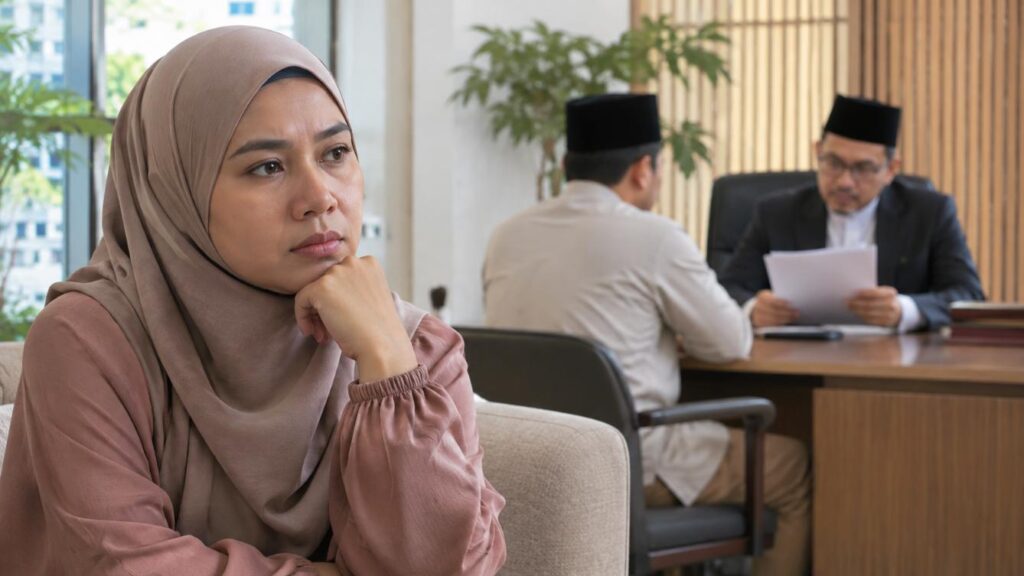
He cannot simply remarry. In Singapore, a polygynous Muslim marriage must be applied for in person at the Registry of Muslim Marriages and approved by a Kadi, who examines whether the man can provide for the financial, physical and emotional well-being of his wives. Only after the Kadi approves, and no appeal is made, can the marriage application be submitted.
What does ROMM require before a man can take a second wife in Singapore?
A man who is already married cannot have a second marriage solemnised by just anyone. Under section 96(2) of the Administration of Muslim Law Act 1966, where the man to be wedded is already married to someone other than his intended bride, the marriage may only be solemnised by a Kadi, or by the woman's wali with the Kadi's written consent. Under section 96(3) of the same Act the Kadi holds an inquiry before deciding.
The Registry of Muslim Marriages sets out on its polygyny page what it is looking for: the man must be capable of providing a life that is balanced in the financial, physical and emotional well-being of his wives; his existing marriage must be in good standing rather than the reason for the second marriage; and there must be a specific benefit that the first marriage cannot provide. ROMM states expressly that love is not a benefit for this purpose, and that a man may have a maximum of four wives at a time.
In my experience that last criterion is where most applications fail. Wanting to marry someone is not a reason; the Kadi is asking what good this marriage does and whether both households can actually be carried.
Steps in a polygynous marriage application at ROMM
| Step | Who does what | Where the existing wife comes in | Fee |
| 1. Polygynous marriage application | The husband submits the application form personally at ROMM; Our Marriage Journey states the application must be made in person and that a fee is charged for every application | Not yet involved | A fee is charged per application |
| 2. Interview with the Kadi | Separate appointments are held with the existing wife or wives, the male applicant and the proposed spouse; statements and evidence are recorded and signed, and Our Marriage Journey states appointment letters are sent within a month of the application and that the application is treated as withdrawn after a third reminder is ignored | She is interviewed on her own and her statement is recorded and signed | Our Marriage Journey states $56 per issuance of summons |
| 3. Outcome | The Kadi approves or refuses the application and notifies the parties | She is told the outcome | — |
| 4. Appeal | An appeal from a Kadi's decision lies to an Appeal Board under section 105 of the Administration of Muslim Law Act 1966; under the Muslim Marriage and Divorce Rules a notice of appeal must be filed within 30 days of the decision, and the decision is not to be carried out except by order of the Appeal Board | This is the stage where an objection is put formally before the Appeal Board | — |
| 5. Marriage application and solemnisation | Our Marriage Journey states the marriage application may only be submitted once the Kadi confirms no appeal has been made, that solemnisation is at least 21 days after submission, and that the application expires 150 days from submission | Not involved | $39 where at least one party is a Singapore citizen, $128 where neither is, under the fee schedule to the Muslim Marriage and Divorce Rules |
Do I have to give my consent as the existing wife?
No. Nothing in section 96 of the Administration of Muslim Law Act 1966 makes your consent a condition of approval, and nothing makes your objection fatal either. What you have is the right to be heard: ROMM's published process gives the existing wife her own separate appointment with the Kadi, where her statement and evidence are recorded and signed.
This is where I disagree with the common view in the community that a wife has no say at all. She is not a bystander. The Kadi is deciding whether this man can keep two households whole, and the person with the clearest evidence of how the first household is actually run is the first wife.
I also tell wives who say they will "just agree" to keep the peace that agreement is not neutral. Once you have said in a recorded statement that everything at home is fine and the money is sufficient, that statement does not disappear if you are later arguing about maintenance or the flat.
Before you attend the interview or see a lawyer, gather:
- Your marriage certificate and the children's birth certificates.
- Bank statements, payslips and CPF statements, yours and any of his you properly have.
- A record of what he actually gives for the household each month, and for how long.
- Household bills, school fees, medical and rental or mortgage records.
- Documents for the flat, including the HDB records and who has been paying.
- Messages or letters about the proposed marriage, his income or his other commitments.
Can I object or appeal against the Kadi's decision?
Yes, there is an appeal route, and it is time-limited. Under section 105 of the Administration of Muslim Law Act 1966, an appeal from a decision of a Kadi or Naib Kadi lies to an Appeal Board constituted under section 55, and the Islamic Religious Council of Singapore describes that Appeal Board as hearing appeals against decisions of the Syariah Court, the Kadi and the Naib Kadi.
The Muslim Marriage and Divorce Rules require a notice of appeal to be filed within 30 days of the date of the decision, and provide that the Kadi's decision is not to be carried out except by order of the Appeal Board while that appeal stands.
That 30 days is short. It is also why ROMM's own process says the marriage application may only be submitted once the Kadi confirms no appeal has been made — approval is not the end of the matter the moment it is given. If you intend to challenge a decision, see a lawyer in the first days, not the fourth week, because the grounds have to be prepared properly.
What if my husband marries overseas instead?
A ceremony abroad does not put the marriage through the Kadi's inquiry, and it does not produce the ROMM approval letter that the Singapore process requires before a marriage application can be submitted here. Whether such a marriage is recognised in Singapore depends on where and how it was contracted, and that is not something a general article can answer for your situation.
What we often see is that the problem surfaces later rather than at the ceremony: when a child's documents are needed, when housing or immigration applications are made, when money has to be traced, or when someone dies and the estate has to be distributed.
My practical advice is simple. Do not argue about whether the overseas ceremony "counts". Deal with what you can prove and what you need — maintenance, the children, and the roof over your head — and take advice on status separately.
What happens to my nafkah, the flat and the children if he remarries?
A second marriage does not switch off his obligations to you and your children. It does stretch the same income across two households, and that is usually the real issue a first wife is facing.
If the marriage later ends, nafkah iddah and mutaah are assessed against his means, so what he spends on a second family is relevant to the argument, not a defence to it. Our note on how mutaah is assessed by the Syariah Court explains how that works in practice.
For the flat, division of matrimonial property on divorce is dealt with in the Syariah Court, and the Islamic Religious Council of Singapore lists division of matrimonial property and custody of minor children among the matters its Appeal Board hears on appeal. One misconception I correct often: it is not only jointly held assets that can be divided. We cover this in what you can keep after a divorce.
Child maintenance is different. It is applied for at the Family Justice Courts, not the Syariah Court, and we set out that process in our guide on child maintenance in Muslim marriages.
Can I file for a Muslim divorce because my husband took a second wife?
A second marriage is not, by itself, an automatic ground for divorce. Whether you have a claim depends on what has happened in your marriage — neglect, failure to maintain, cruelty, or a breach of the terms of your taklik — and divorce for Muslim marriages is filed in the Syariah Court. Under the Muslim Marriage and Divorce Rules, prescribed parties must attend the prescribed activity before applying to the Court for divorce, which is why counselling comes before filing. You can read our step-by-step note on how to apply for a Muslim divorce in Singapore.
In this video I run through the misconceptions I hear most: child maintenance belongs at the Family Justice Courts, a wife can still get divorced even if her husband refuses to pronounce talak or turn up, nusyuz may lower nafkah but it is still payable, nafkah cannot come from CPF and need not be paid in one shot, mothers do not always get care and control, and non-joint assets can be divisible too.
Here I explain when nafkah iddah may not be payable — talak wajib, divorce by way of hakam, and on some views fasakh — while noting that opinions differ, and that in one case nafkah iddah was still ordered after a triple talak because the principle of ihsan gives the judge quite a bit of leeway.
Frequently asked questions
Is polygamy legal for Muslims in Singapore?
Polygyny is permitted, but it is controlled. Section 96(2) of the Administration of Muslim Law Act 1966 means a man who is already married cannot have another marriage solemnised except by a Kadi, or by the wali with the Kadi's written consent, and ROMM states the maximum is four wives at a time. In practice, the application and the Kadi's inquiry are the gatekeepers.
Will ROMM tell me if my husband applies?
You should hear from ROMM. Its published process provides for separate appointments with the current wife or wives, the applicant and the proposed spouse, with appointment letters posted to each of them and sent out within a month of the application. If you have moved, make sure your registered address is up to date, because that is where the letter goes.
Can a second marriage be registered without my knowledge?
The Singapore process is not designed to allow that. Because the Kadi must hold an inquiry under section 96(3) of the Administration of Muslim Law Act 1966 and interview the existing wife, you would normally be called in before any approval. If you believe a marriage has been registered without that process, raise it with ROMM and take advice quickly.
Is a second marriage done overseas recognised in Singapore?
It depends on where and how the ceremony took place, and it is not the same as a polygynous marriage approved by a Kadi and registered here. A foreign ceremony bypasses the inquiry that Singapore law requires. Rather than assume either way, bring the documents to a lawyer and get your position checked before you act on it.
Does a second marriage reduce the maintenance I receive?
It does not reduce your entitlement automatically, but it does affect the practical arithmetic, because the same income is now being spread further. Maintenance for you and for the children is assessed on his means and needs, and if payment stops or drops you can take that to court. As I say in the video above, even where a wife is said to be nusyuz, nafkah may be lowered but is still payable.
If your husband has applied to take a second wife, or has already married again, speak to us before you sign or say anything you cannot take back. You can call or WhatsApp Emerald Law LLC on +65 9711 8078, or read more about the Syariah and family matters we handle.
This article is general information, not legal advice. Please speak to a lawyer about your situation.
Sources
- Administration of Muslim Law Act 1966 (sections 96 and 105) – Singapore Statutes Online
- Muslim Marriage and Divorce Rules (including fees and appeal provisions) – Singapore Statutes Online
- Registry of Muslim Marriages – Polygyny
- Our Marriage Journey – Polygynous marriage: interview with Kadi
- Our Marriage Journey – Polygynous marriage: submit marriage application
- Our Marriage Journey – Polygynous marriage: finalise key details
- Our Marriage Journey – Muslim marriage process
- Ask.gov.sg (Our Marriage Journey) – How do I apply for a polygynous marriage?
- Islamic Religious Council of Singapore (Muis) – Appeal Board
Popular Post
-
 Can My Husband Take a Second Wife Without My Consent?23 Nov 2026
-
 Affair and Care and Control in a Muslim Divorce (SG)19 Nov 2026
-
 How Much CPF Can I Get in a Muslim Divorce? Singapore12 Nov 2026
-
 Paying For Everything And Care And Control: Muslim Divorce09 Nov 2026
-
 Can a Non-Muslim Spouse Inherit? Muslim Estates SG09 Nov 2026
Meet Our Team

Mohammad Rizuan
Joint Managing Director

Sharifah Ally
Director

Russel Thio
Senior Associate
Request an Appointment
For more information or to book a free consultation, please contact us now!